
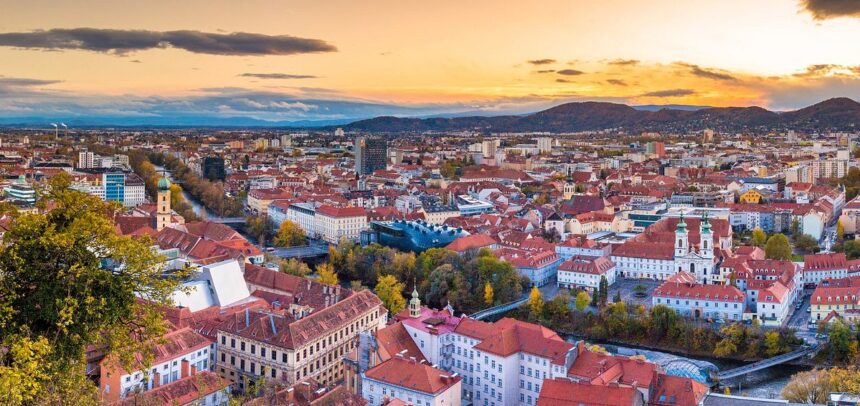
Graz, spreading out along both banks of the Mur River in southeastern Austria, is a city built on a uniquely captivating aesthetic layout.
For centuries, it served as a vital imperial residence for the Inner Austrian line of the Habsburg dynasty, a legacy that left behind one of the most impeccably preserved historic old towns in Central Europe.
However, what truly sets the Styrian capital apart is its strong Mediterranean flair. Influenced by Italian Renaissance master builders who traveled north, the city is a canvas of terracotta-tiled roofs, elegant arcaded courtyards, and warm, sun-drenched public squares.
Designated as both a UNESCO World Heritage site and a UNESCO City of Design, Graz seamlessly pairs its centuries-old architecture with mind-bending contemporary art landmarks.
1. The Grazer Uhrturm (Clock Tower) & Schloßberg
The Fortified Peak and the Clock of Inverted Hands
Rising over 120 meters straight out of the city center, the Schloßberg is a massive dolomite hill that once held an absolute powerhouse of a medieval fortress, anchored by its iconic 28-meter-tall wooden-balconied clock tower.
- What it is famous for: Its legendary resistance against Napoleon and its uniquely swapped clock hands. When Napoleon destroyed the Schloßberg fortress in 1809, the citizens of Graz paid a massive ransom to save the Uhrturm from demolition. Crucially, the clock’s hands are reversed: the large hand indicates the hour and the small hand indicates the minutes, a design choice meant to help townspeople read the time from far down in the valley below.

2. Kunsthaus Graz
The Biomorphic “Friendly Alien” of the Riverbank
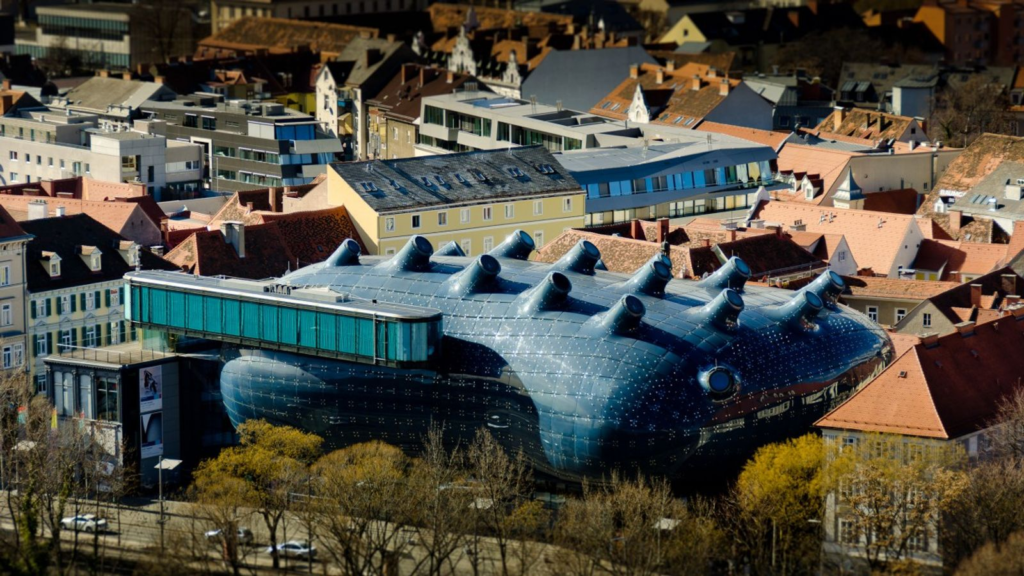
Exhibiting a spectacular contrast to its surroundings on the western bank of the Mur River, this ultra-modern contemporary art museum was built in 2003 by architects Peter Cook and Colin Fournier to celebrate Graz’s tenure as the European Capital of Culture.
- What it is famous for: Its bulbous, nozzle-studded blue skin and its role as an architectural icon. Known affectionately by locals as the “Friendly Alien,” the building’s organic, irregular shape is made of thousands of curved acrylic glass panels. The outer skin functions as a giant media facade (BIX Media Facade), using circular fluorescent lights beneath the surface to project shifting digital art installations across the river toward the old town every evening.
3. Eggenberg Palace (Schloss Eggenberg)
The Cosmic Renaissance Masterpiece of Mathematical Order
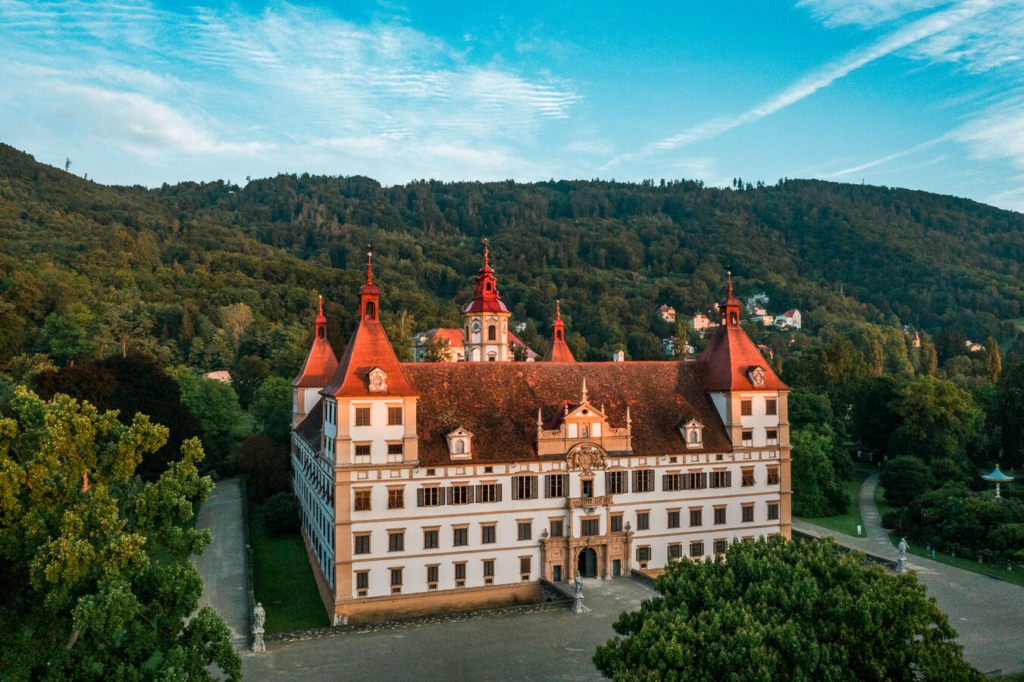
Located on the western edge of the city, this breathtaking 17th-century palace complex was commissioned by Prince Hans Ulrich von Eggenberg, the governor of Inner Austria, who wanted a residence that reflected the harmony of the universe.
- What it is famous for: Its ingenious cosmic, astronomical architecture and roaming peacocks. The entire palace is a physical calendar: it features exactly 365 windows, 31 rooms per floor, 24 state rooms, and 4 corner towers representing the seasons. The crowning jewel inside is the magnificent Planetary Room, lined with intricate Baroque frescoes of the zodiac. Outside, beautiful, sprawling English-style gardens are famously populated by dozens of proud, roaming peacocks.
4. The Murinsel (Mur Island)
The Floating Steel Seashell of the Rushing River
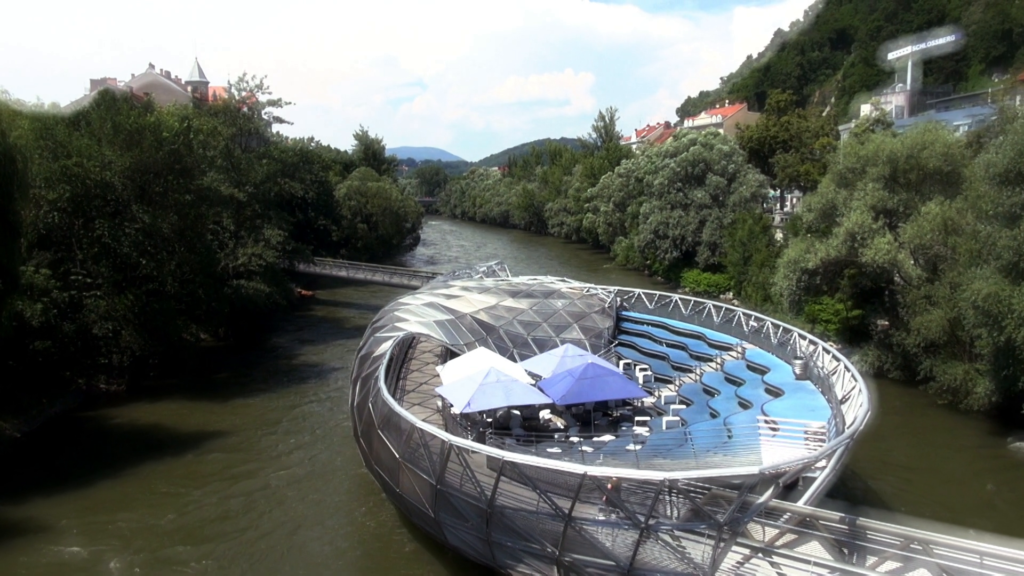
Anchored directly in the middle of the rushing waters of the Mur River, this striking, floating platform was designed by American artist Vito Acconci and completed as a hallmark project of the city’s 2003 cultural transformation.
- What it is famous for: Its interlocking seashell-and-open-bowl shape that bridges two riverbanks. Accessible by two pedestrian footbridges, the lattice-like steel and glass island contains an amphitheater for outdoor events and a trendy, blue-lit cafe. At night, the entire structure glows with a vibrant blue neon light, looking like a brilliant, high-tech vessel floating gracefully against the river currents.
5. The Landhaus & Landhaushof
The Tuscan Renaissance Palace of Imperial Architecture
Located along the bustling main avenue of Herrengasse, this grand 16th-century palace was designed by Italian master architect Domenico dell’Allio to serve as the seat of the Styrian regional parliament.
- What it is famous for: Its jaw-dropping, three-story arcaded courtyard. The Landhaushof is widely considered the absolute pinnacle of Renaissance architecture in Austria. The interior courtyard features beautiful, uniform rows of arched loggias, intricate stone balustrades, and an ornate, bronze Renaissance fountain. In the winter, this historic courtyard serves as the dramatic stage for the city’s famous, giant ice nativity scene (Eiskrippe).

6. The Styrian Armoury (Landeszeughaus)
The World’s Largest Living Time Capsule of Medieval Warfare
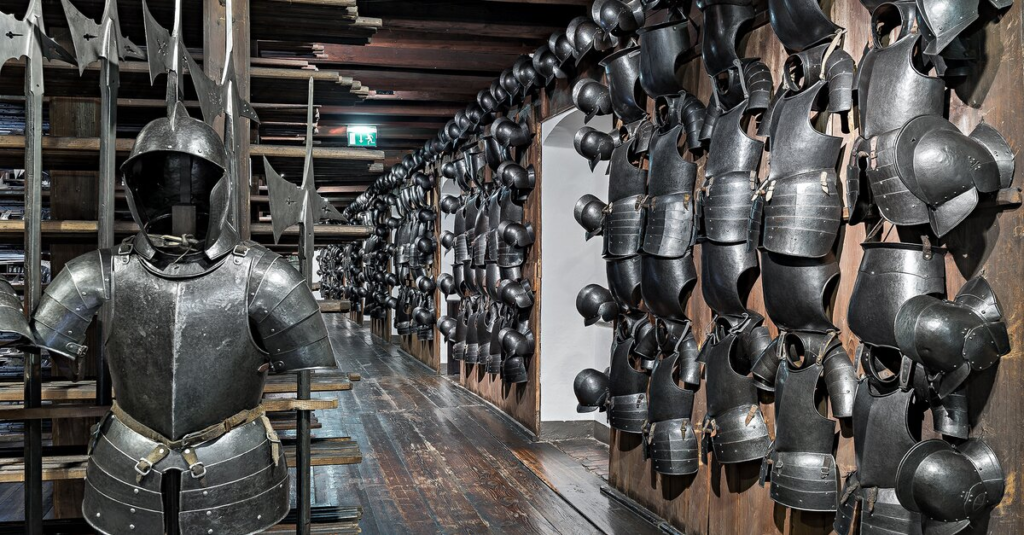
Directly attached to the grand Landhaus palace complex, this massive, five-story stone storehouse was constructed between 1642 and 1645 to serve as the primary defensive weapons depot for the province of Styria.
- What it is famous for: Housing the largest historical collection of authentic weapons and armor on Earth. Unlike typical museums, the Landeszeughaus preserves its collection exactly as a working military depot would. It guards over 32,000 historic items, including rows of full suits of plate armor, heavy muskets, intricate pistols, swords, and specialized armor designed for warhorses, all systematically arranged on original wooden racks to defend against historical Ottoman invasions.
7. Graz Cathedral & Imperial Mausoleum
The Double-Headed Crown of Gothic Faith and Mannerist Drama
Standing side-by-side on an elevated historic terrace in the eastern sector of the old town, this architectural pair comprises the late-Gothic 15th-century cathedral and the adjacent 17th-century final resting place of Emperor Ferdinand II.
- What it is famous for: The rare, faded “Plagues of God” fresco and the spectacular Mannerist dome. The cathedral exterior holds a legendary fresco from 1485 depicting the three plagues that struck Graz simultaneously: locusts, war, and the black death. Right next door, the Mausoleum—designed by Italian architect Giovanni Pietro de Pomis—features a turquoise-domed silhouette that forms one of the most celebrated and regal vistas in the city skyline.

8. The Double Spiral Staircase (Doppelwendeltreppe)
The Stone Masterpiece of Gothic Optical Illusion
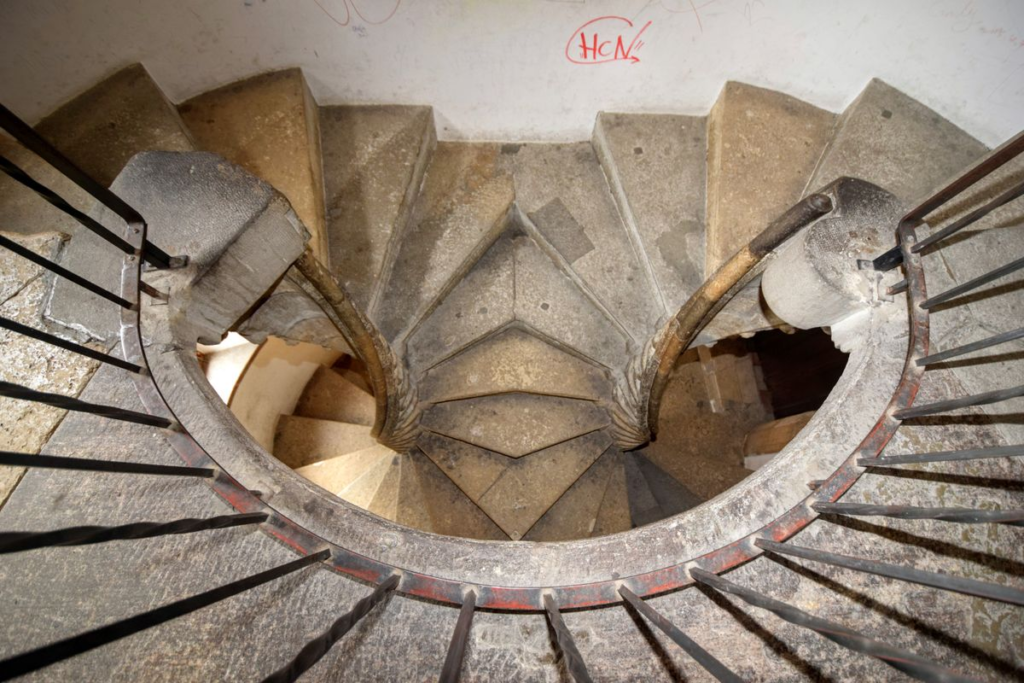
Tucked inside the quiet courtyard of the Grazer Burg (the historic city castle), this unassuming stone staircase was constructed in 1499 under the rule of Emperor Maximilian I.
- What it is famous for: Its mind-bending, twin-helix “Staircase of Reconciliation.” The stone steps split into two separate paths that wind upward in opposite directions before seamlessly merging back together on every floor. It is celebrated as a absolute masterpiece of late-Gothic stonemasonry. Local romantic tradition says that if lovers part ways at the bottom and meet back up at the merging points, their love will last forever.
9. Hauptplatz & The Grazer Rathaus (City Hall)
The Bustling Red-Tile Focal Point of the Realm
Serving as the primary social and physical center of Graz since the early Middle Ages, this massive, triangular public market square opens up spectacularly to reveal the monumental, late-19th-century historicist City Hall.
- What it is famous for: Its vibrant daily food trucks and towering central bronze fountain. The historic square is bordered by stunning, painted facades like the Luegg House, which is covered in complex Baroque stucco decorations. The center of the cobblestone marketplace is anchored by the Archduke Johann Fountain, surrounded by lively, traditional street-food stalls where locals stand to eat grilled sausages and drink fresh local Styrian wines.

10. Glockenspielplatz
The Dancing Wooden Mechanical Carillon of the Square
This charming, small historic public square is hidden away in the pedestrian zone of the old town, surrounded by elegant, historic townhouses that once belonged to wealthy local merchants.
- What it is famous for: The three-times-daily performance of the mechanical Glockenspiel. At exactly 11:00 AM, 3:00 PM, and 6:00 PM, two arched wooden doors at the top of a historic building gable swing wide open. A mechanical wooden Tyrolean maiden and a young man in traditional dress emerge to spin and dance to a sequence of 24 chiming bells, a performance that has delighted crowds since a local brewery owner installed it in 1905.

11. The Sporgasse
The Steeply Winding Fashion Runway of the Middle Ages
Tracing its path from the corner of the Hauptplatz straight up toward the base of the Schloßberg hill, this narrow, steeply winding cobblestone lane is one of the oldest and most atmospheric streets in Graz.
- What it is famous for: Its extraordinary display of diverse architectural styles and historic facades. Walking up the pedestrian avenue treats travelers to an open-air architectural catalog, ranging from the Gothic stone portals of old artisan shops to the magnificent Baroque facade of the House of the Teutonic Knights. Today, this high-energy lane is packed with independent fashion boutiques, artisan bakeries, and the city’s most popular ice cream parlors.